Independent router help & how-tosHelping you find your connection.
The guide library

Mac uses Wi-Fi while Ethernet is connected: inspect network service order

Explore the guide library · Mac network help

Set an intentional preference between active connections and verify the real task after docking or undocking.
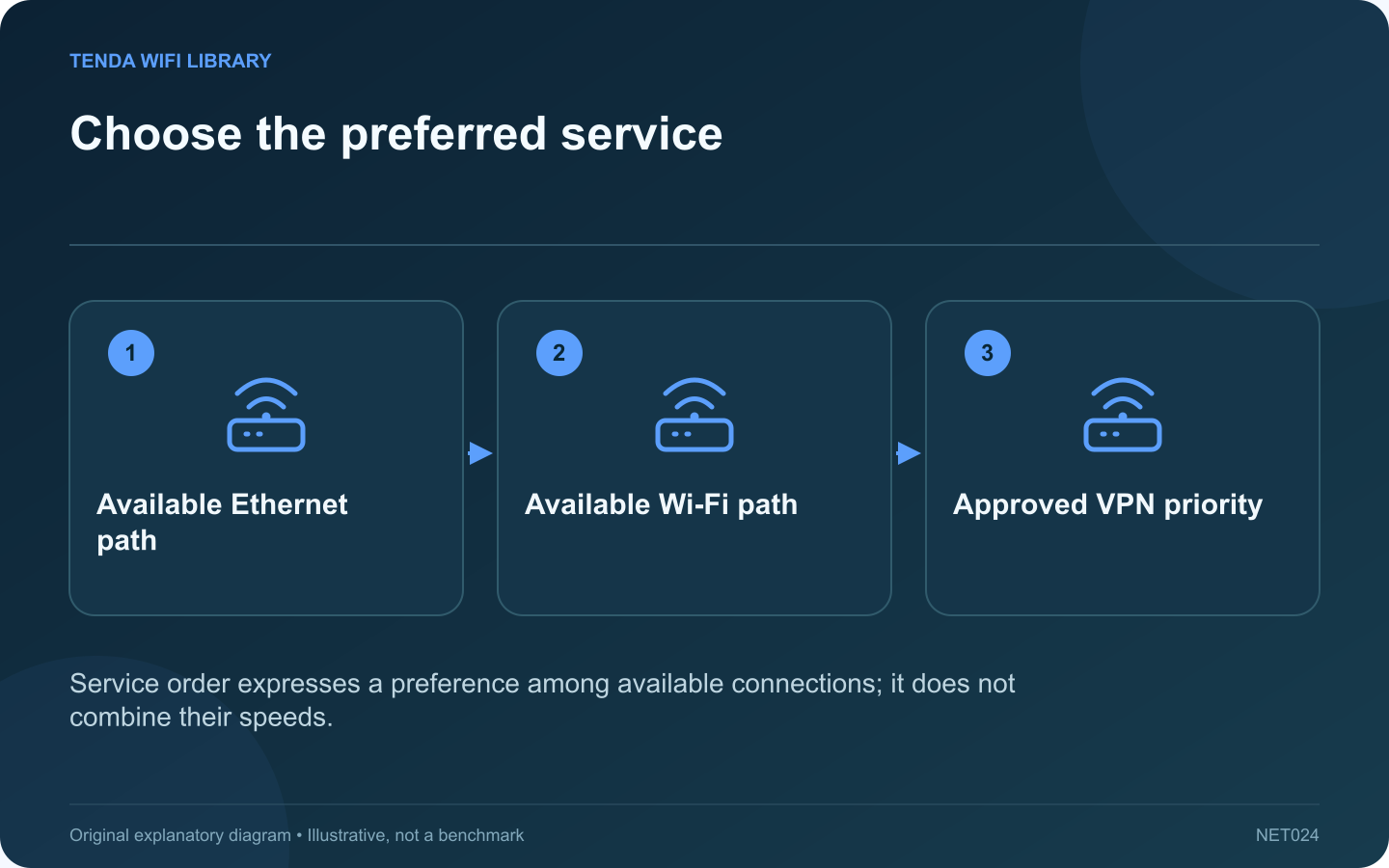
Choose the preferred service: Available Ethernet path; Available Wi-Fi path; Approved VPN priority
Service order expresses a preference among available connections; it does not combine their speeds.

A Mac with both Wi-Fi and Ethernet available may not use the connection you expected. Network service order helps establish which ordinary service the computer tries first. This is especially useful for a desk setup where a dock provides the preferred wired connection.

Confirm Ethernet actually works

Check the dock’s network service and its connection status before changing priorities. An attached cable is not proof that the service has a usable address or route. Inspect the far-end port and compare a known-working cable if the wired service appears disconnected.

Review the current order

Apple documents the Set Service Order command in System Settings under Network’s action menu. Place the intended service in the appropriate position and save. Keep a note of the original order so an unexpected effect can be reversed.

Understand the limits

This preference does not bond Wi-Fi and Ethernet into one faster connection. Apple also notes that VPN connections already take priority over non-VPN connections and cannot be reordered through this control. A managed VPN can therefore affect the observed route even after ordinary services are rearranged.

Verify the desk workflow

  1. Connect the dock and wait for Ethernet to become available.
  2. Test the actual file transfer, call or service used at the desk.
  3. Finish active work before undocking.
  4. Confirm Wi-Fi provides the expected connection afterward.

Keep local resources in mind

Different connections may reach different printers or storage systems. If a resource disappears only when the preferred connection changes, inspect the network each interface joins rather than assuming the application is broken.

For a work-managed Mac, coordinate changes with the administrator. The successful result is predictable behavior at the desk and away from it, with the required VPN and security controls still active. Avoid deleting the secondary service merely to hide an unresolved problem in the primary connection.

Sources and editorial notes

Sources checked 8–9 October 2026. Independent guidance and original illustrations; product comparisons use published specifications rather than hands-on benchmarks. Check the exact model, revision and regional documentation before changing settings.

Related guides

300 FAQs across our guide libraries

Quick answers

100 practical questions from Tenda WiFi Library.

Browse all 100 FAQs
Why might a Mac use Wi-Fi while Ethernet is connected?

A Mac with both Wi-Fi and Ethernet available may not use the connection you expected. Network service order helps establish which ordinary service the computer tries first. This is especially useful for a desk setup where a dock provides the preferred wired connection. Check the dock's network service and its connection status before changing priorities. An attached cable is not proof that the service has a usable address or route. Inspect the far-end port and compare a known-working cable if the wired service appears disconnected.

Read the full guide and sources
Which Mac interface should receive a renewed DHCP lease?

A Mac can have several network services, including Wi-Fi, a dock's Ethernet connection and virtual interfaces. When investigating an address problem, renew the DHCP lease on the service actually carrying the affected connection. Changing a different service may produce no useful effect. Open System Settings, choose Network, select the relevant service and inspect its Details and TCP/IP settings. Record the address, router value and configuration method privately. Apple documents that the renewal control is available when the service uses DHCP.

Read the full guide and sources
Are Mac DNS servers and search domains the same setting?

The DNS panel on a Mac contains a server list and a search-domain list. Both affect name resolution, but they are not interchangeable. Putting the same value into both fields can leave a configuration that looks complete while failing to resolve the intended resource. A DNS server entry identifies a resolver by its IPv4 or IPv6 address. That service answers name queries according to its configuration. Apple provides separate controls for adding or removing these server addresses in the selected network service's DNS settings.

Read the full guide and sources
How can Mac network locations preserve different connection settings?

A Mac that moves between home and an office may need different network settings. An old manual value can follow the computer into a place where it no longer belongs. Network locations provide a way to organize separate sets of settings and preserve a known configuration during testing. Write down whether the environments use different service order, proxy behavior, DNS details or manual addressing. Do not assume every failed connection needs a new location. The feature is most useful when a concrete configuration difference explains the problem.

Read the full guide and sources
Independent. Practical. Clear.

Tenda WiFi Library is an independent information website. We are not affiliated with or endorsed by Tenda. Product names belong to their respective owners.