Independent router help & how-tosHelping you find your connection.
The guide library

AirDrop works while the internet is down: why that does not clear the router

Explore the guide library · Apple device connections

Distinguish nearby Apple-device sharing from ordinary internet access before interpreting a successful transfer.
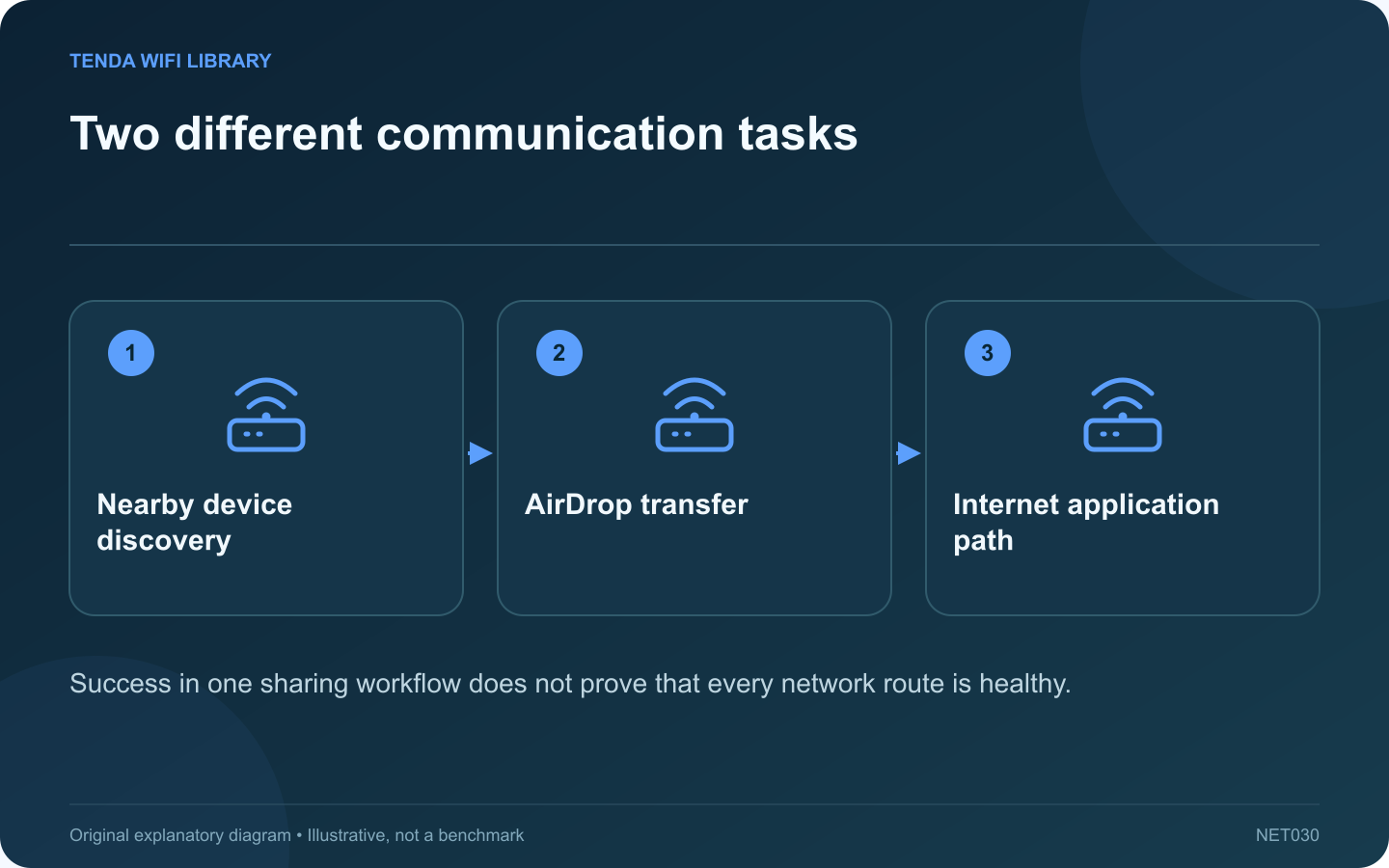
Two different communication tasks: Nearby device discovery; AirDrop transfer; Internet application path
Success in one sharing workflow does not prove that every network route is healthy.

A successful AirDrop transfer can be reassuring when a Mac or iPhone has network trouble. However, it does not establish that the home router’s internet connection is working. Nearby sharing and a web request are different tasks with different requirements.

Check AirDrop’s own requirements

Apple’s guidance calls for Wi-Fi and Bluetooth to be enabled on nearby participating devices, along with suitable receiving settings. Confirm the intended recipient and use a harmless test file. Do not broaden receiving availability indefinitely just to diagnose another network problem.

Test internet access independently

On the affected device, open the intended website and a second unrelated public destination. Confirm whether a phone is using cellular data or the home Wi-Fi path. A phone that silently uses mobile data can make a household outage appear device-specific.

Separate discovery from completion

Seeing a recipient in AirDrop means discovery succeeded under those conditions. Completing a transfer adds evidence about that sharing task. Neither result confirms the provider connection, DNS behavior or availability of an unrelated remote service.

Watch for a change of path

Apple documents that some AirDrop transfers can continue over the internet after devices leave nearby range. Record whether the devices remained close and which connections were available. Avoid treating every successful AirDrop transfer as proof that it used only a local path.

Use the comparison constructively

  • If nearby sharing works but public sites fail, investigate the internet path separately.
  • If public sites work but AirDrop fails, inspect discovery, receiving settings and device compatibility.
  • If an approved VPN is involved, ask whether its policy permits the required local networking.

Keep the test focused on the user’s actual goal. A router replacement is not justified by an AirDrop discovery problem alone, and a successful nearby transfer is not enough to dismiss a real broadband outage affecting the household.

Sources and editorial notes

Sources checked 8–9 October 2026. Independent guidance and original illustrations; product comparisons use published specifications rather than hands-on benchmarks. Check the exact model, revision and regional documentation before changing settings.

Related guides

300 FAQs across our guide libraries

Quick answers

100 practical questions from Tenda WiFi Library.

Browse all 100 FAQs
Does working AirDrop prove that internet access is working?

A successful AirDrop transfer can be reassuring when a Mac or iPhone has network trouble. However, it does not establish that the home router's internet connection is working. Nearby sharing and a web request are different tasks with different requirements. Apple's guidance calls for Wi-Fi and Bluetooth to be enabled on nearby participating devices, along with suitable receiving settings. Confirm the intended recipient and use a harmless test file. Do not broaden receiving availability indefinitely just to diagnose another network problem.

Read the full guide and sources
Could Low Data Mode pause iPhone backups or downloads?

An iPhone can browse normally while photo synchronization or automatic backups remain paused. That pattern may reflect intentional data-saving behavior. Low Data Mode can restrict background activity even when the phone is connected to Wi-Fi with a strong signal. Read the reason shown beside the paused task. Storage limits, power conditions and account issues can also affect synchronization. Do not assume every pending upload is a network fault simply because the task needs the internet.

Read the full guide and sources
Why can an iPhone casting app fail to see a television?

A streaming application can play video on an iPhone yet show no television in its casting list. Internet playback and local-device discovery are separate operations. A denied Local Network permission is one possible explanation when the TV and phone are otherwise correctly connected. Confirm that the television or streaming receiver supports the casting method used by the app. A generic smart-TV label does not mean every protocol is supported. Open the receiver's relevant feature and check its connection state.

Read the full guide and sources
What can an Apple limited-compatibility warning mean on Wi-Fi 6E?

A supported Apple device can display a limited-compatibility message when joining a newer Wi-Fi network. This is different from a simple wrong-password error. Apple's current guidance links this behavior to how the router names its 2.4, 5 and 6 GHz bands. Check the exact device model against Apple's current compatibility information. A recent product name does not guarantee every variant supports the same bands. Regional availability also matters, particularly for features using 6 GHz.

Read the full guide and sources
Independent. Practical. Clear.

Tenda WiFi Library is an independent information website. We are not affiliated with or endorsed by Tenda. Product names belong to their respective owners.