Explore the guide library · Mobile data and hotspots
Choose the connection method by laptop support, cable availability and the working environment rather than a universal speed claim.
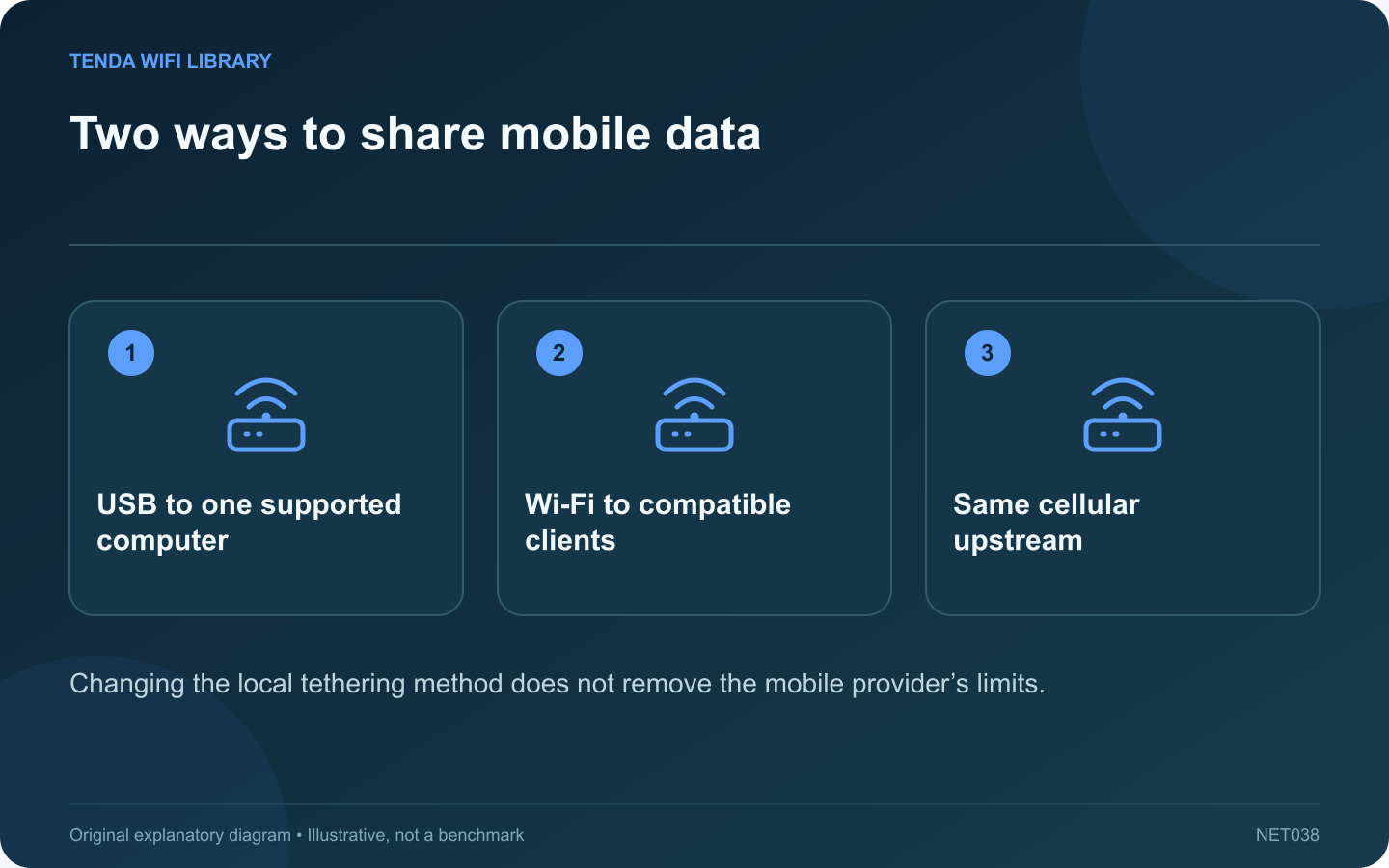
For one laptop during a broadband outage, Android USB tethering and a Wi-Fi hotspot are two possible ways to use the phone’s mobile connection. The best choice depends on the actual computer and phone, not a guarantee that one method always produces a faster internet result.
Check support before choosing
Google documents USB, Bluetooth and Wi-Fi tethering on supported Android phones, with carrier restrictions possible. Its general guidance specifically notes that Mac computers cannot use Android USB tethering through that standard workflow. Check the current instructions for your exact devices.
Consider USB for a supported desk setup
A suitable data cable can provide a direct local connection to one supported computer. Charging alone does not prove that the cable carries data. Confirm the tethering interface appears and use the phone’s normal USB tethering control.
Consider Wi-Fi for flexibility
A hotspot lets compatible clients connect without a cable. Use a strong password and confirm the client selected your actual hotspot. Placement now has two concerns: the phone needs usable cellular reception, and the laptop needs a reliable local wireless connection to it.
Compare with a small real task
- Keep the phone in a similar location.
- Use the same application and destination.
- Record stability and practical usability.
- Watch mobile-data usage and device temperature.
Plan the end of the session
Turn tethering off when it is no longer needed. Review postponed laptop transfers before returning to ordinary broadband. A background backup can consume the mobile allowance regardless of which tethering method carried it.
Keep the phone on an appropriate power arrangement for a long session and follow its temperature guidance. Choose the method that works reliably with the hardware already available. Buying a new router will not resolve an unsupported tethering interface or a carrier plan that does not permit the intended use.
Sources and editorial notes
Sources checked 8–9 October 2026. Independent guidance and original illustrations; product comparisons use published specifications rather than hands-on benchmarks. Check the exact model, revision and regional documentation before changing settings.