Independent router help & how-tosHelping you find your connection.
The guide library

Chromecast on guest Wi-Fi: why internet access can work while discovery fails

Explore the guide library · Streaming device connections

Check the network’s intended isolation and current casting workflow before resetting the receiver.
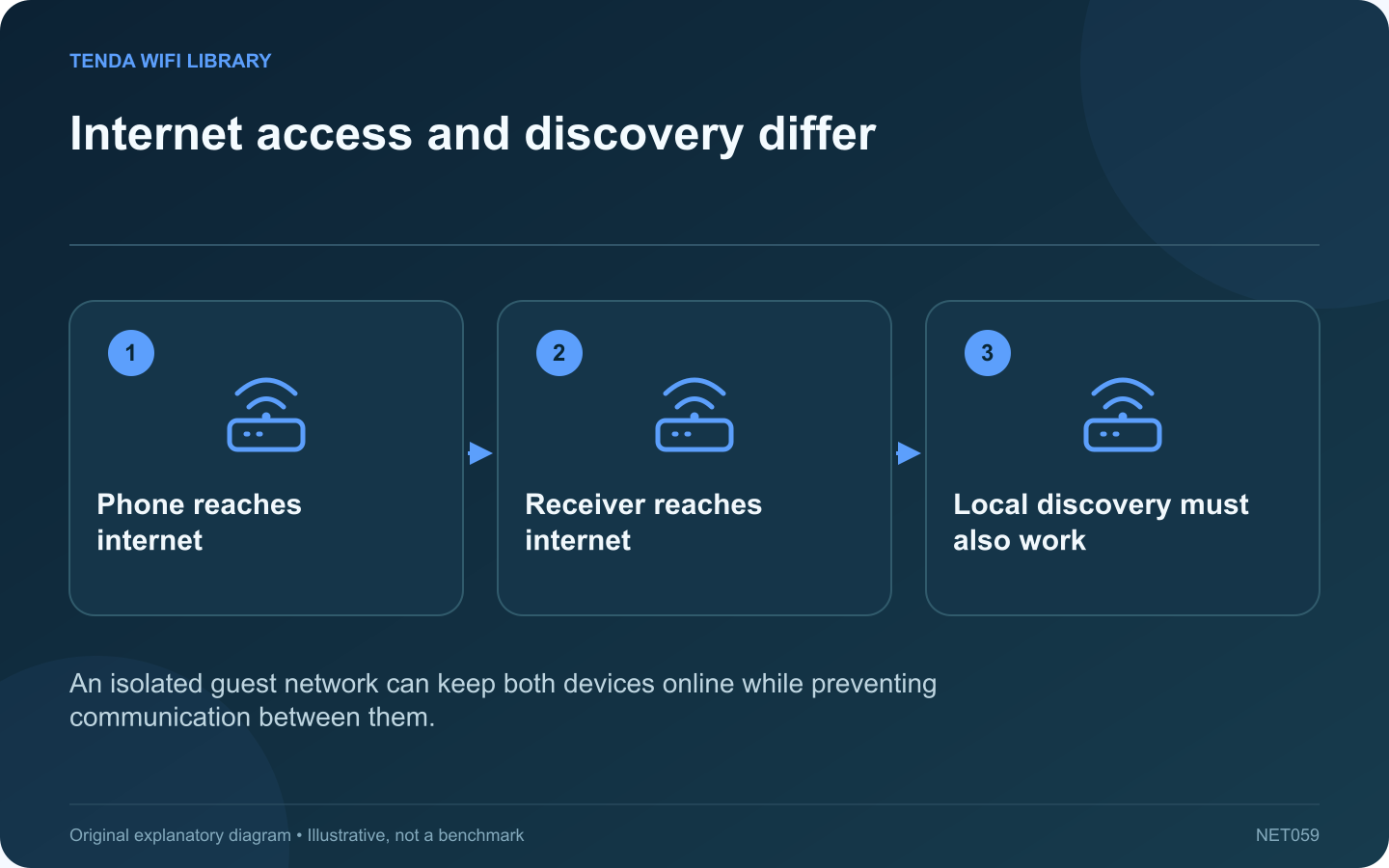
Internet access and discovery differ: Phone reaches internet; Receiver reaches internet; Local discovery must also work
An isolated guest network can keep both devices online while preventing communication between them.

A phone and streaming receiver can both reach the internet yet remain unable to discover each other. Guest networks often isolate clients or separate them from household devices. That policy can be useful for visitors while being unsuitable for a particular casting workflow.

Identify the actual network arrangement

Check the phone’s Wi-Fi name and the receiver’s configured network. Similar names do not guarantee that both devices share a permitted local path. An extender can also have settings that affect communication between its clients.

Review the supported requirements

Google’s streaming-device guidance identifies AP or client isolation as a possible setup obstacle. It also notes that captive-portal networks, common in hotels, are not supported by the documented ordinary setup workflow.

Choose an appropriate trusted segment

On a network you administer, place the intended devices on a secure segment that permits the required local communication. Avoid removing isolation from every guest merely to make one receiver visible. A router with explicit shared-device controls may offer a more limited arrangement; use its documentation.

Do not rely on obsolete guest instructions

Google states that the older Chromecast guest mode is no longer supported. A tutorial based on entering its guest PIN may therefore describe a workflow that is unavailable now.

Verify discovery and playback

  1. Confirm the receiver is ready.
  2. Check the setup app’s required local permissions.
  3. Discover the intended receiver.
  4. Start a small playback session.

If the network belongs to a hotel, school or employer, ask its administrator for a supported arrangement rather than attempting to bypass its controls. Preserve the distinction between a device being online and being locally reachable. That distinction can explain a failed casting list without requiring a factory reset, a new router or a weaker network for everyone else.

Sources and editorial notes

Sources checked 8–9 October 2026. Independent guidance and original illustrations; product comparisons use published specifications rather than hands-on benchmarks. Check the exact model, revision and regional documentation before changing settings.

Related guides

300 FAQs across our guide libraries

Quick answers

100 practical questions from Tenda WiFi Library.

Browse all 100 FAQs
Why can Chromecast discovery fail on guest Wi-Fi?

A phone and streaming receiver can both reach the internet yet remain unable to discover each other. Guest networks often isolate clients or separate them from household devices. That policy can be useful for visitors while being unsuitable for a particular casting workflow. Check the phone's Wi-Fi name and the receiver's configured network. Similar names do not guarantee that both devices share a permitted local path. An extender can also have settings that affect communication between its clients.

Read the full guide and sources
Do AirPlay mirroring and internet streaming use the same path?

A television can play its own internet app smoothly while screen mirroring from a Mac stutters. Conversely, a nearby sharing session may work during a broadband problem. These results are not contradictory: discovery, mirroring and remote content retrieval can use different paths. Record whether you are mirroring the whole screen, sending media through an application or using an app directly on the receiver. Include the source device and receiver model. The word streaming alone is too broad to identify the failing connection.

Read the full guide and sources
Why can a Mac app fail to discover a device on the local network?

A Mac application may load internet content successfully yet fail to discover a speaker, printer or local server. In supported macOS versions, Local Network privacy controls can limit whether a particular app finds and communicates with nearby network devices. Check that the target is powered on and connected to the intended network. Compare its own status display or official app guidance. A guest network with intentional isolation can prevent local access even when both devices have excellent internet connectivity.

Read the full guide and sources
Why might Windows Mobile hotspot connect without internet access?

A phone can successfully join a Windows Mobile hotspot while still lacking internet access. That proves the phone reached the laptop's hotspot, but the laptop must also have a working connection selected for sharing. Open an ordinary public page and the service you intend to use. If Windows itself has no internet, fix that source connection first. A public network may require a legitimate sign-in flow before it allows ordinary traffic.

Read the full guide and sources
Independent. Practical. Clear.

Tenda WiFi Library is an independent information website. We are not affiliated with or endorsed by Tenda. Product names belong to their respective owners.