Independent router help & how-tosHelping you find your connection.
The guide library

Gigabit vs 2.5G Ethernet for a laptop: when the upgrade saves time

Explore the guide library · Network adapter comparisons

Estimate the benefit from the work you do rather than upgrading every port because a higher number is available.
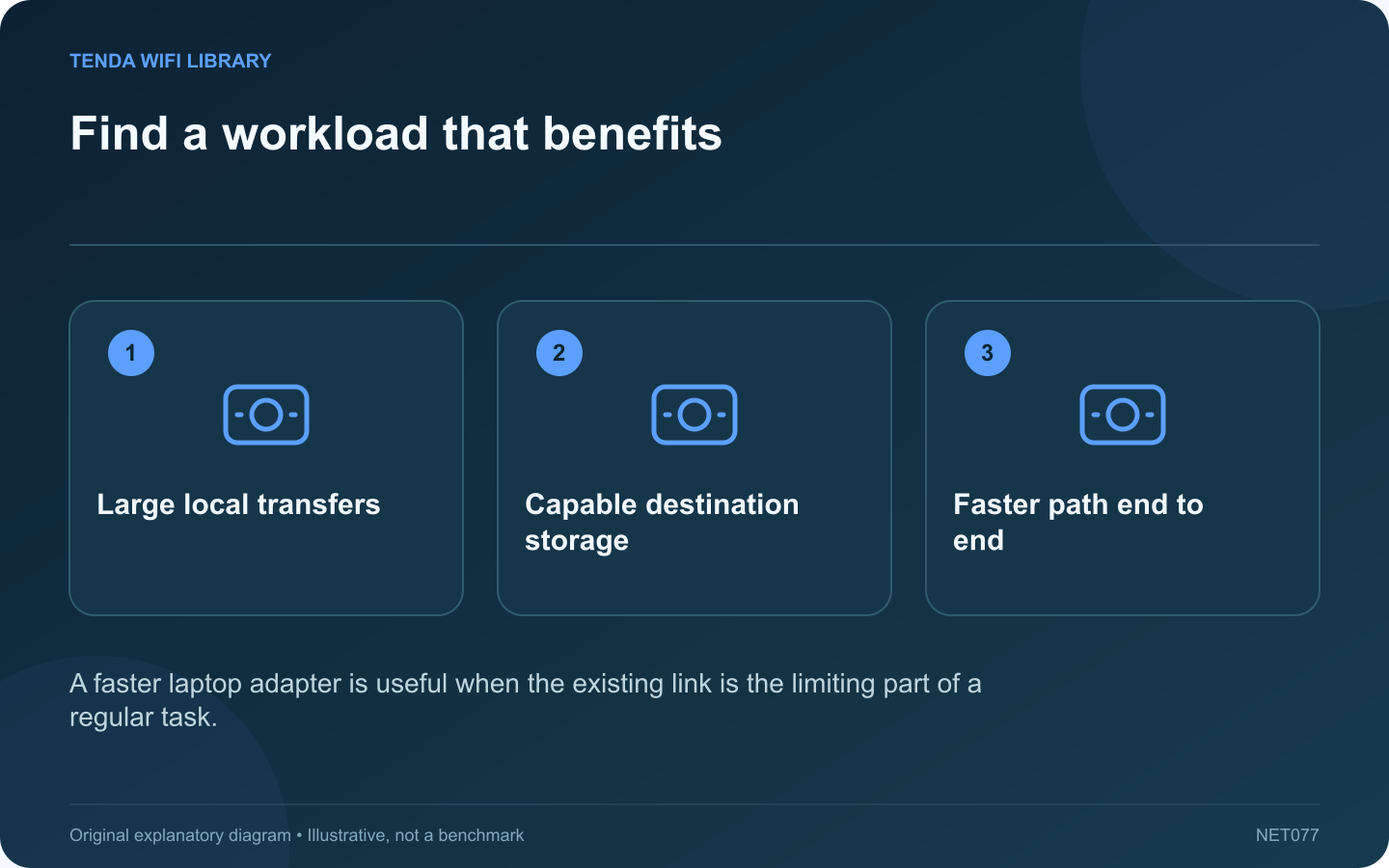
Find a workload that benefits: Large local transfers; Capable destination storage; Faster path end to end
A faster laptop adapter is useful when the existing link is the limiting part of a regular task.

A laptop’s Gigabit Ethernet connection may already handle video calls, browsing and a modest internet plan comfortably. Moving to 2.5G is most compelling when a frequent transfer actually runs into the existing wired link’s capacity.

Start with a timed task

Choose a real job such as copying a video project to a NAS. Record its size and elapsed time with the existing adapter. Keep the same files and destination for the comparison. A synthetic speed result matters less than whether the daily task finishes sooner.

Identify the other limits

A slow source disk, encrypted archive operation or overloaded server can hold the transfer below Gigabit capacity. Check those constraints before buying an adapter and switch together. A network-only test between computers you control can help separate link capacity from storage performance.

Estimate an upper bound

A 10 GB decimal file contains about 80 gigabits. Dividing by 1 Gbps gives 80 seconds; dividing by 2.5 Gbps gives 32 seconds. These are ideal arithmetic limits, not promised copy times. Protocol overhead, storage and application behavior make real transfers slower.

Compare the full cost

  • A compatible laptop adapter and available USB port.
  • A 2.5G switch or router LAN port.
  • A destination that can receive at the higher rate.
  • Any cable or docking changes required by the actual layout.

Choose a measurable threshold

Decide how much time saved per week would justify the change. Borrowing or testing one adapter first can reveal whether the destination is already the bottleneck.

If ordinary tasks already perform well, retaining Gigabit is a valid choice. If large local transfers repeatedly saturate it, upgrade the relevant path and repeat the original timed task. Keep both results so the decision rests on the workload you care about rather than the maximum number printed on the packaging.

Sources and editorial notes

Sources checked 8–9 October 2026. Independent guidance and original illustrations; product comparisons use published specifications rather than hands-on benchmarks. Check the exact model, revision and regional documentation before changing settings.

Related guides

300 FAQs across our guide libraries

Quick answers

100 practical questions from Tenda WiFi Library.

Browse all 100 FAQs
When does a laptop benefit from 2.5G rather than Gigabit Ethernet?

A laptop's Gigabit Ethernet connection may already handle video calls, browsing and a modest internet plan comfortably. Moving to 2.5G is most compelling when a frequent transfer actually runs into the existing wired link's capacity. Choose a real job such as copying a video project to a NAS. Record its size and elapsed time with the existing adapter. Keep the same files and destination for the comparison. A synthetic speed result matters less than whether the daily task finishes sooner.

Read the full guide and sources
What should I compare on UE302C and USBC-E2500 adapters?

TP-Link's UE302C and Plugable's USBC-E2500 both provide a 2.5 Gigabit Ethernet interface for a compatible computer. The useful difference is how each fits your laptop and support requirements. Neither product makes a gigabit router port operate at 2.5 Gbps. Plugable's connector flexibility can be useful when moving between older desktops and newer laptops. A dedicated Type-C adapter can be simpler if all intended computers already have an appropriate free port. Confirm the exact regional package rather than relying on a marketplace photograph.

Read the full guide and sources
Are Intel AX210 and AX211 interchangeable laptop upgrades?

Intel's AX210 and AX211 can look like interchangeable Wi-Fi 6E upgrades because their radio specifications are similar. The crucial purchase check is the computer-side interface. A module that fits a socket physically is not necessarily supported by the platform behind it. Find the exact laptop or motherboard model and its supported wireless modules. Confirm whether the existing component is replaceable, which interface the socket supports and whether the manufacturer restricts replacements. Do not buy solely from a reseller's broad compatibility claim.

Read the full guide and sources
Are Intel BE200 and BE201 interchangeable Wi-Fi 7 modules?

The BE200 and BE201 belong to Intel's Wi-Fi 7 family, but their similar names conceal an important host-interface difference. A successful upgrade begins with the computer manufacturer's supported configuration, not the largest wireless rate printed in a listing. Check the exact laptop or motherboard service information, socket interface, antenna arrangement and supported firmware. Do not infer compatibility from the presence of an M.2 connector alone. Different uses of that connector can require different electrical support.

Read the full guide and sources
Independent. Practical. Clear.

Tenda WiFi Library is an independent information website. We are not affiliated with or endorsed by Tenda. Product names belong to their respective owners.