Independent router help & how-tosHelping you find your connection.
The guide library

SMB Multichannel vs link aggregation: can two adapters speed up one NAS copy?

Explore the guide library · Local device networking

Separate a file-sharing feature from switch link aggregation before adding a second network interface.
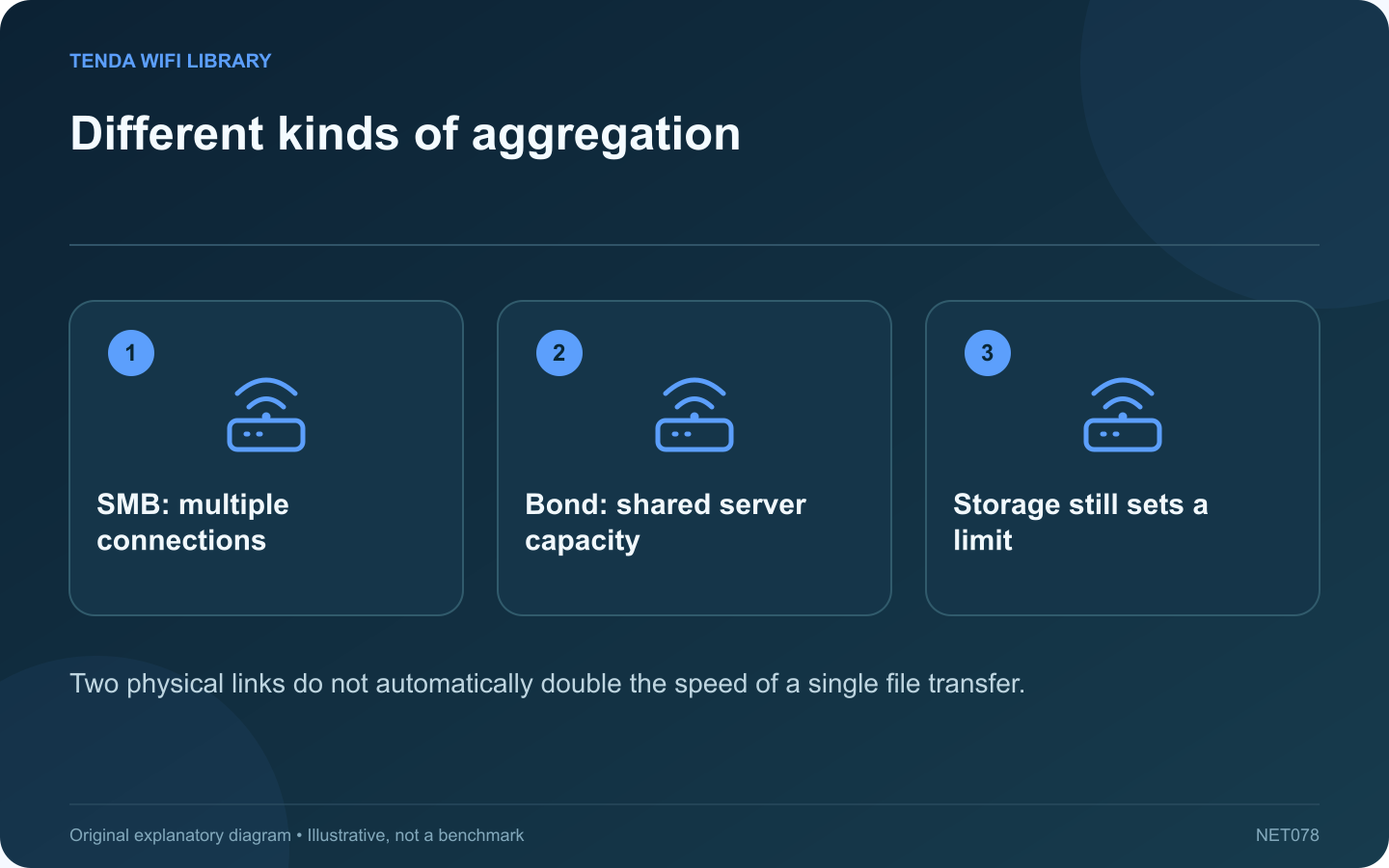
Different kinds of aggregation: SMB: multiple connections; Bond: shared server capacity; Storage still sets a limit
Two physical links do not automatically double the speed of a single file transfer.

Two Ethernet cables connected to a NAS can mean several different configurations. Link aggregation usually helps distribute traffic across links, while SMB Multichannel lets a supported SMB session use multiple connections. They are not interchangeable buttons for doubling a laptop’s file-copy speed.

State the target workload

Do you want one laptop to copy faster, or several family members to access the NAS simultaneously? That distinction determines which feature deserves investigation. An aggregate server-capacity improvement can be useful even if one individual transfer stays near the speed of a single link.

Check both ends

Synology documents operating-system, DSM and adapter requirements for SMB Multichannel. Review the exact current requirements for your NAS and client. Mixing a slow wireless connection with a faster wired interface does not establish that their advertised rates will simply add together.

Understand the single-adapter case

Receive-side scaling can spread processing work when supported. It does not turn one physical Gigabit port into a two-gigabit wire. Distinguish reduced CPU pressure from additional physical bandwidth when reading a performance claim.

Make a small test plan

  1. Measure a normal SMB copy with the existing arrangement.
  2. Verify that the selected feature is supported at both ends.
  3. Apply the documented configuration during a maintenance window.
  4. Confirm multiple connections are actually in use.
  5. Repeat the same transfer and inspect storage load.

Avoid accidental topology changes

Do not connect redundant switch cables or create a bond without understanding the required switch configuration. Preserve the NAS management path and a documented way to undo the change.

The successful result is a repeatable improvement for the intended workload. A second adapter that remains unused, a saturated disk or an unsupported operating-system combination will not be rescued by another cable. Verify the active SMB behavior before expanding the installation to additional computers.

Sources and editorial notes

Sources checked 8–9 October 2026. Independent guidance and original illustrations; product comparisons use published specifications rather than hands-on benchmarks. Check the exact model, revision and regional documentation before changing settings.

Related guides

300 FAQs across our guide libraries

Quick answers

100 practical questions from Tenda WiFi Library.

Browse all 100 FAQs
Is SMB Multichannel the same as link aggregation?

Two Ethernet cables connected to a NAS can mean several different configurations. Link aggregation usually helps distribute traffic across links, while SMB Multichannel lets a supported SMB session use multiple connections. They are not interchangeable buttons for doubling a laptop's file-copy speed. Do you want one laptop to copy faster, or several family members to access the NAS simultaneously? That distinction determines which feature deserves investigation. An aggregate server-capacity improvement can be useful even if one individual transfer stays near the speed of a single link.

Read the full guide and sources
What should I check when Quick Share cannot find my Windows PC?

When an Android phone cannot find a Windows computer in Quick Share, the first problem is discovery. Changing the router's channel or purchasing a faster adapter is premature until the two devices can identify each other. Google provides Quick Share for supported Windows computers and directs Samsung PC owners to Samsung's version in Microsoft Store. Check the current requirements for your processor and Windows version. Use the official download route rather than an unrelated file-sharing utility with a similar name.

Read the full guide and sources
Should I use Windows Nearby sharing or Google Quick Share?

Windows Nearby sharing and Google Quick Share are different transfer features. Turning on one does not guarantee that a device using the other will appear. Start with the sending and receiving platforms before troubleshooting discovery. Microsoft documents Nearby sharing over Bluetooth or Wi-Fi between supported Windows devices. Google publishes separate app, platform and connectivity requirements for Quick Share. Consult the relevant guide rather than mixing setup steps from the two products.

Read the full guide and sources
When does a laptop benefit from 2.5G rather than Gigabit Ethernet?

A laptop's Gigabit Ethernet connection may already handle video calls, browsing and a modest internet plan comfortably. Moving to 2.5G is most compelling when a frequent transfer actually runs into the existing wired link's capacity. Choose a real job such as copying a video project to a NAS. Record its size and elapsed time with the existing adapter. Keep the same files and destination for the comparison. A synthetic speed result matters less than whether the daily task finishes sooner.

Read the full guide and sources
Independent. Practical. Clear.

Tenda WiFi Library is an independent information website. We are not affiliated with or endorsed by Tenda. Product names belong to their respective owners.