Independent router help & how-tosHelping you find your connection.
The guide library

Low ping when idle, lag during downloads: compare loaded latency

Explore the guide library · Performance testing

Measure responsiveness during ordinary traffic instead of judging the network only while it is quiet.
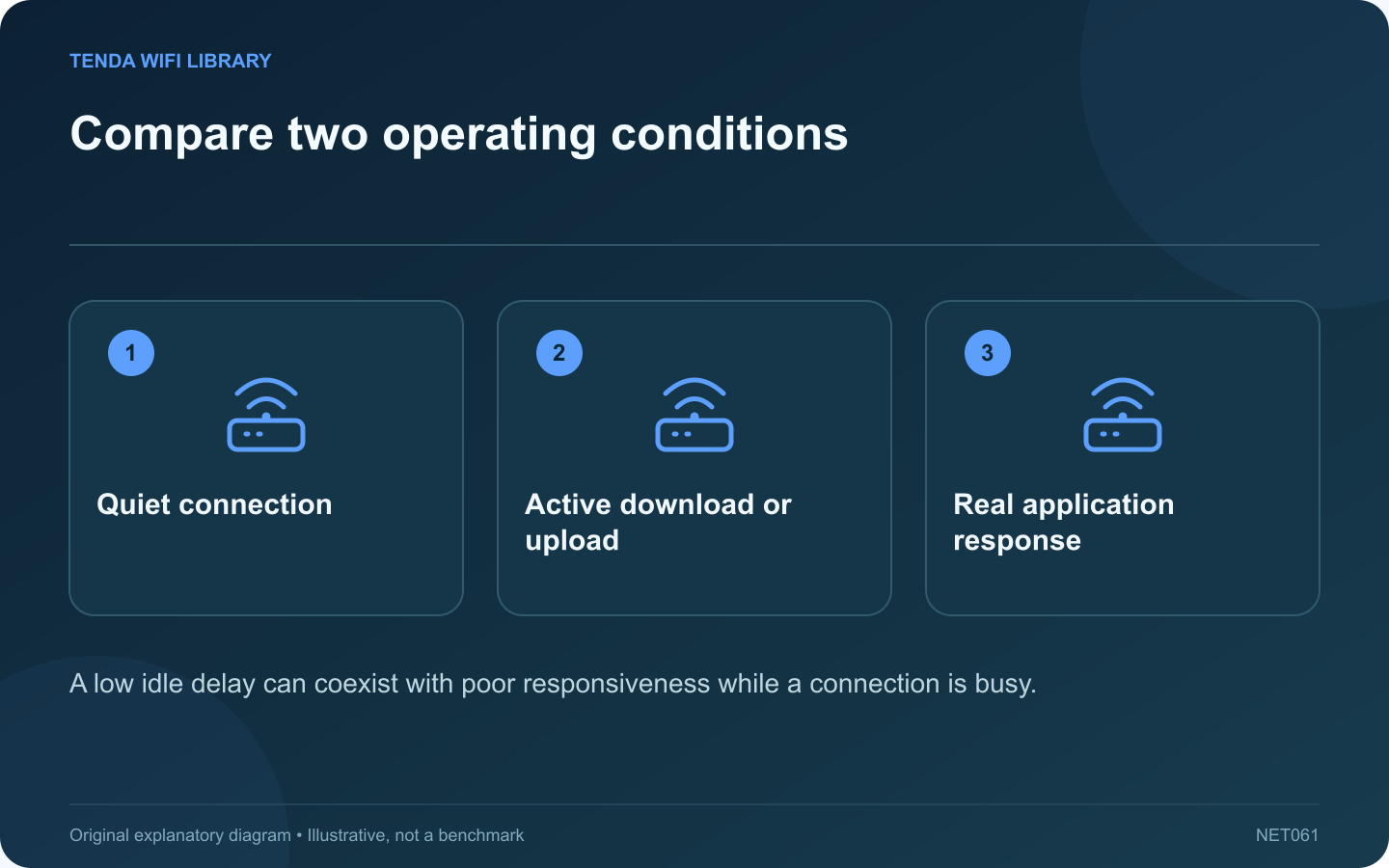
Compare two operating conditions: Quiet connection; Active download or upload; Real application response
A low idle delay can coexist with poor responsiveness while a connection is busy.

A home connection can produce a low ping when idle and still feel unresponsive during a download. The useful question is how delay changes under load. This helps explain why a faster headline download rate does not always translate into a smoother call or game.

Record the quiet baseline

Use a consistent test method and destination when the household connection is relatively quiet. Record latency and the current connection type. A wireless result beside the router should not be compared directly with a later result from a distant bedroom.

Measure a busy condition

Cloudflare distinguishes unloaded latency from latency measured during upload or download activity. Use a tool that reports these separately, or observe the application’s own diagnostics during a controlled transfer you own. Run the test outside an important meeting.

Keep the comparison repeatable

  1. Use the same device and network path.
  2. Record whether upload or download activity is present.
  3. Note any competing household traffic.
  4. Repeat a few times at the same location.
  5. Compare the range rather than choosing one favorable number.

Locate the likely contention

If a wired comparison shows the same delay increase, inspect the shared upstream path and traffic management. If the increase is mainly wireless, investigate local airtime and placement as well. These are clues for further testing, not proof of a single faulty component.

Choose a proportionate correction

Schedule optional bulk transfers, use supported application rate controls or evaluate the router’s documented queue-management features when appropriate. Change one factor and repeat the original workload.

Do not assume that buying a higher wireless class will fix queues beyond the access point. A useful outcome is better responsiveness while the household performs its normal mix of tasks. Record both throughput and delay so an apparent speed improvement does not hide a worse experience for time-sensitive applications.

Sources and editorial notes

Sources checked 8–9 October 2026. Independent guidance and original illustrations; product comparisons use published specifications rather than hands-on benchmarks. Check the exact model, revision and regional documentation before changing settings.

Related guides

300 FAQs across our guide libraries

Quick answers

100 practical questions from Tenda WiFi Library.

Browse all 100 FAQs
Why does gaming lag appear only during large downloads?

A home connection can produce a low ping when idle and still feel unresponsive during a download. The useful question is how delay changes under load. This helps explain why a faster headline download rate does not always translate into a smoother call or game. Use a consistent test method and destination when the household connection is relatively quiet. Record latency and the current connection type. A wireless result beside the router should not be compared directly with a later result from a distant bedroom.

Read the full guide and sources
How do latency, jitter and packet loss differ?

A choppy call may happen on a connection with ample download capacity. Real-time communication depends on more than moving a large file quickly. Latency, jitter and packet loss describe different parts of the experience and should be recorded separately. Latency concerns how long an exchange takes. Jitter concerns variation in timing. Packet loss concerns data that does not arrive as expected. Cloudflare includes these alongside throughput and loaded latency when assessing application-oriented internet quality.

Read the full guide and sources
When should I compare single-stream, parallel and reverse iperf3 tests?

Two iperf3 results can differ greatly because they used different options. A single stream, several parallel streams and a reverse-direction test are different workloads. Label the configuration before comparing numbers or declaring one router faster than another. Begin with the ordinary client-to-server test between authorized local computers. Record duration, software version and connection type. Avoid introducing several performance flags before establishing a repeatable baseline that resembles the task you want to improve.

Read the full guide and sources
Why is Windows Wi-Fi link rate higher than download speed?

Windows may display a wireless link rate much higher than the result from a speed test. These figures describe different things. The first concerns the radio connection; the second measures useful traffic across a longer path that includes additional equipment and services. Use Windows network properties or the documented netsh wlan show interfaces command to inspect the active connection. Note the band, receive and transmit rates when available, adapter model and test location. These values can change as radio conditions change.

Read the full guide and sources
Independent. Practical. Clear.

Tenda WiFi Library is an independent information website. We are not affiliated with or endorsed by Tenda. Product names belong to their respective owners.