Independent router help & how-tosHelping you find your connection.
The guide library

Fast downloads but slow uploads: identify the limit before changing Wi-Fi

Explore the guide library · Connection performance tests

Compare the service’s upload allowance, current background traffic and a controlled wired result.
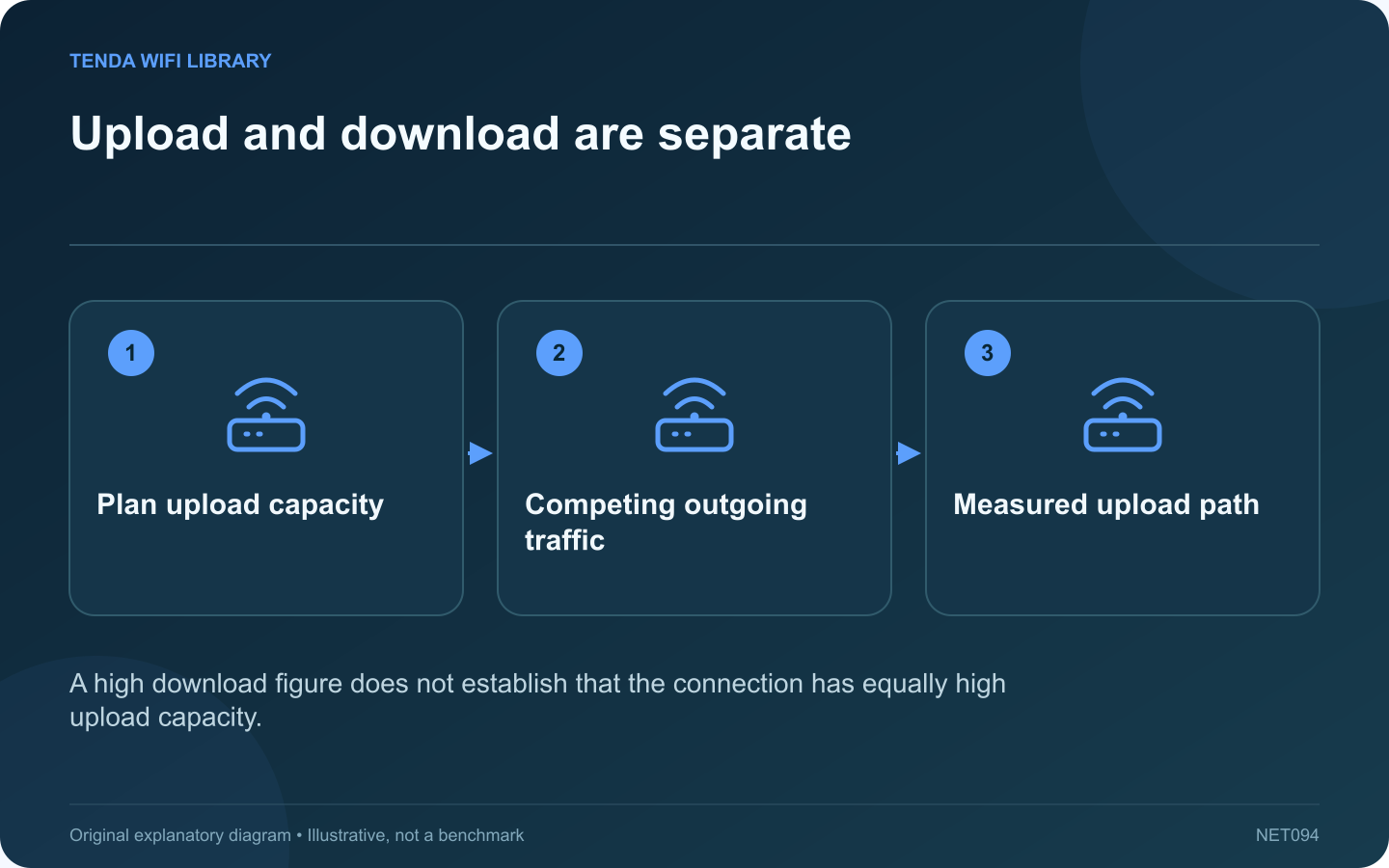
Upload and download are separate: Plan upload capacity; Competing outgoing traffic; Measured upload path
A high download figure does not establish that the connection has equally high upload capacity.

A connection can download quickly while taking much longer to upload a video or backup. The service may provide different capacities in each direction, and ongoing uploads can consume the smaller allowance before you start a test.

Check the service specification

Look up the upload speed included with the current plan. Do not infer it from the advertised download headline. Record the units and any provider guidance on expected performance so the target is based on the actual service.

Identify outgoing activity

Cloud backups, photo synchronization, security cameras and file transfers may send data continuously. Ask other users before interrupting their work. If possible, pause one optional large upload briefly and repeat the same test.

Compare a wired baseline

Use a capable computer connected by Ethernet to separate some wireless variables from the internet measurement. Keep the same test destination and avoid running another speed test at the same time. Record both upload throughput and responsiveness during the transfer.

Inspect application limits

A cloud application may impose its own transfer limit. Microsoft’s OneDrive guidance documents upload and download rate controls. Check the actual application setting before assuming the router is preventing higher throughput.

Interpret the pattern

Result Next investigation
All devices show the same low upload Plan capacity, shared traffic or provider path
Only one device is slow Client connection and software
Only one service is slow Application limits and destination behavior

These are directions for investigation rather than automatic diagnoses. Repeat the relevant result before purchasing hardware or changing a service plan.

After identifying the bottleneck, schedule or limit optional uploads so essential calls and work have room to function. Keep necessary backups enabled and choose a realistic completion window. The aim is a usable connection throughout the day, not merely a larger number on an isolated upload test.

Sources and editorial notes

Sources checked 8–9 October 2026. Independent guidance and original illustrations; product comparisons use published specifications rather than hands-on benchmarks. Check the exact model, revision and regional documentation before changing settings.

Related guides

300 FAQs across our guide libraries

Quick answers

100 practical questions from Tenda WiFi Library.

Browse all 100 FAQs
Why can uploads remain slow when downloads are fast?

A connection can download quickly while taking much longer to upload a video or backup. The service may provide different capacities in each direction, and ongoing uploads can consume the smaller allowance before you start a test. Look up the upload speed included with the current plan. Do not infer it from the advertised download headline. Record the units and any provider guidance on expected performance so the target is based on the actual service.

Read the full guide and sources
Why do two internet speed-test services disagree?

Two speed-test services can report different throughput or latency within a few minutes. Each result describes a measurement to a particular endpoint using a particular method. Neither is a universal score for every destination on the internet. Note the test service and server location when displayed. One endpoint may be close to your provider, while another uses a different route. Cloudflare's documentation, for example, describes measurements to its own network edge rather than to every application you might use.

Read the full guide and sources
How do I fairly compare phone and laptop Wi-Fi speeds?

A phone outperforming a laptop on the same Wi-Fi does not prove that the laptop is broken. Different radios, antennas, supported bands and software can produce different results. Start by making the test conditions comparable. Place the devices near the same position and test them one after the other, not simultaneously. Keep the laptop lid in its usual working position. A phone beside the router and a laptop behind a metal desk are not measuring the same wireless conditions.

Read the full guide and sources
How do I make a fair VPN speed comparison?

A VPN speed comparison becomes difficult to interpret when the laptop moves rooms, the test server changes and a different protocol is selected at the same time. Build a small controlled comparison so the result answers one question. On a work device, use only the organization's approved VPN configuration. Do not disconnect a required tunnel or bypass its traffic policy for a benchmark. On a personal service, compare options that meet your privacy and location requirements.

Read the full guide and sources
Independent. Practical. Clear.

Tenda WiFi Library is an independent information website. We are not affiliated with or endorsed by Tenda. Product names belong to their respective owners.