Independent router help & how-tosHelping you find your connection.
The guide library

How to compare VPN speeds without changing five variables at once

Explore the guide library · Connection performance tests

Keep the client, location and test destination consistent when comparing approved VPN servers or protocols.
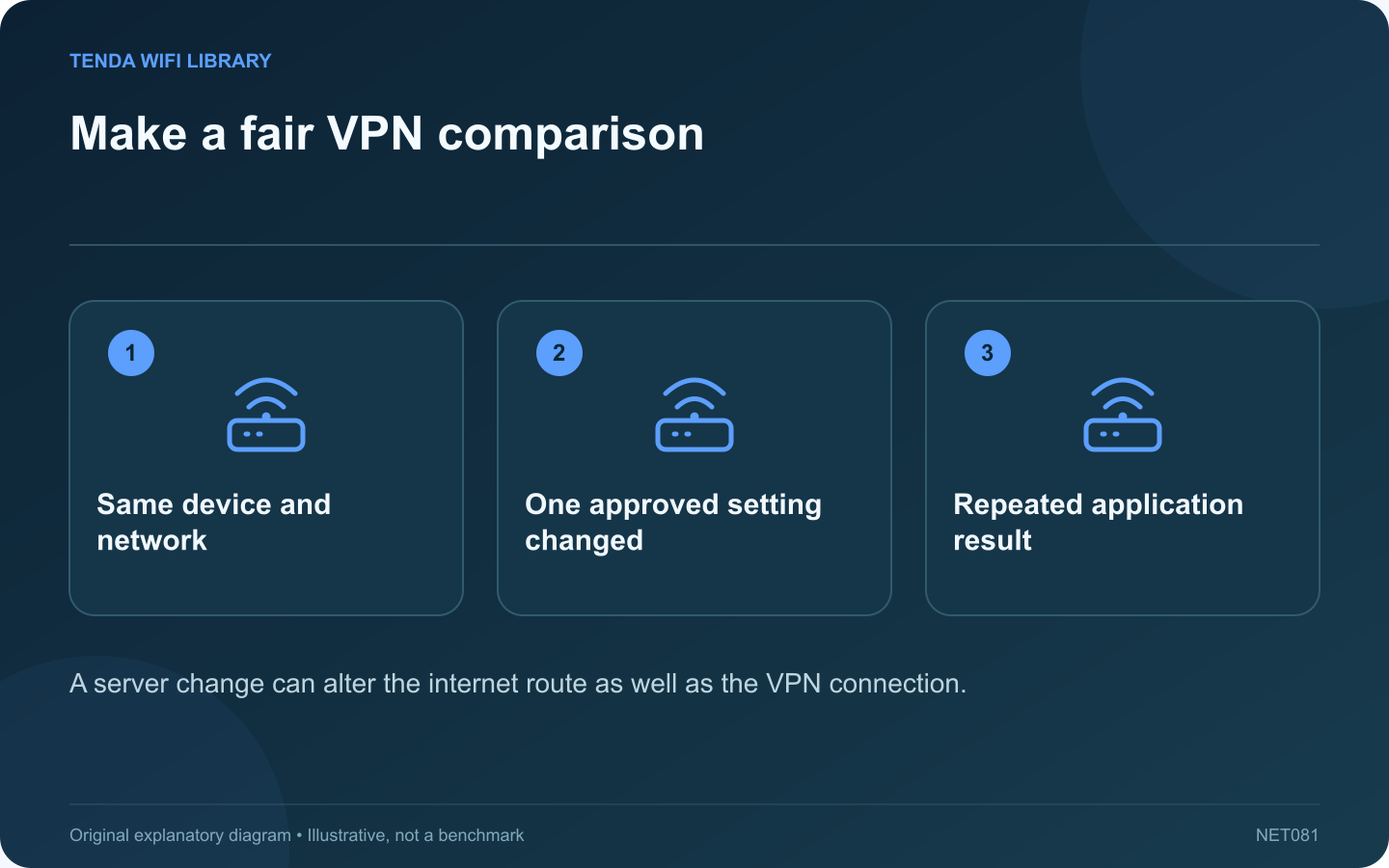
Make a fair VPN comparison: Same device and network; One approved setting changed; Repeated application result
A server change can alter the internet route as well as the VPN connection.

A VPN speed comparison becomes difficult to interpret when the laptop moves rooms, the test server changes and a different protocol is selected at the same time. Build a small controlled comparison so the result answers one question.

Define the permitted choices

On a work device, use only the organization’s approved VPN configuration. Do not disconnect a required tunnel or bypass its traffic policy for a benchmark. On a personal service, compare options that meet your privacy and location requirements.

Hold the local setup constant

Use one computer, the same connection and the same physical location. Pause optional large transfers with their owners’ agreement. Record whether the laptop is on battery or external power. These details help explain a result that otherwise looks like a VPN problem.

Change one setting

Compare two permitted servers while retaining the same protocol, or compare supported protocols on the same server location. Provider documentation explains that servers and protocols can behave differently, but it does not establish a universal fastest choice for your route.

Record more than download speed

  • Upload throughput for file submission or calls.
  • Latency to the destination you use.
  • Whether the connection stays established.
  • The actual task’s completion time.

Use a fixed test destination where the tool allows it. A VPN can change which automatic test server is selected, making two displayed results less comparable.

Repeat before deciding

Run a short sequence such as A, B, then A again. If the first option changes substantially on its second run, background conditions may be influencing the comparison. Avoid declaring a winner from one unusually good result.

Keep the setting that reliably meets the task and security requirements. If all permitted choices perform poorly, give the provider the server identifiers, times and test method. Do not include account secrets or browsing history. A reproducible comparison is more useful than a screenshot of a single low number.

Sources and editorial notes

Sources checked 8–9 October 2026. Independent guidance and original illustrations; product comparisons use published specifications rather than hands-on benchmarks. Check the exact model, revision and regional documentation before changing settings.

Related guides

300 FAQs across our guide libraries

Quick answers

100 practical questions from Tenda WiFi Library.

Browse all 100 FAQs
How do I make a fair VPN speed comparison?

A VPN speed comparison becomes difficult to interpret when the laptop moves rooms, the test server changes and a different protocol is selected at the same time. Build a small controlled comparison so the result answers one question. On a work device, use only the organization's approved VPN configuration. Do not disconnect a required tunnel or bypass its traffic policy for a benchmark. On a personal service, compare options that meet your privacy and location requirements.

Read the full guide and sources
How do I fairly compare phone and laptop Wi-Fi speeds?

A phone outperforming a laptop on the same Wi-Fi does not prove that the laptop is broken. Different radios, antennas, supported bands and software can produce different results. Start by making the test conditions comparable. Place the devices near the same position and test them one after the other, not simultaneously. Keep the laptop lid in its usual working position. A phone beside the router and a laptop behind a metal desk are not measuring the same wireless conditions.

Read the full guide and sources
How do Mbps and MB/s differ in game-download readings?

A game client reporting 50 MB/s is not necessarily underperforming on a 400 Mbps connection. The first number counts megabytes per second and the second counts megabits. One byte contains eight bits, so the units must be aligned before judging the result. Multiply a decimal MB/s value by eight to express it in Mbps. For example, 25 MB/s corresponds to 200 Mbps, while 100 MB/s corresponds to 800 Mbps. These are unit conversions, not predictions of what a particular connection will achieve.

Read the full guide and sources
Why can uploads remain slow when downloads are fast?

A connection can download quickly while taking much longer to upload a video or backup. The service may provide different capacities in each direction, and ongoing uploads can consume the smaller allowance before you start a test. Look up the upload speed included with the current plan. Do not infer it from the advertised download headline. Record the units and any provider guidance on expected performance so the target is based on the actual service.

Read the full guide and sources
Independent. Practical. Clear.

Tenda WiFi Library is an independent information website. We are not affiliated with or endorsed by Tenda. Product names belong to their respective owners.