Independent router help & how-tosHelping you find your connection.
The guide library

Firefox Max Protection DNS warning: understand why fallback may stop

Explore the guide library · Browser and DNS help

Read the selected DNS protection level before treating a resolver warning as a whole-network outage.
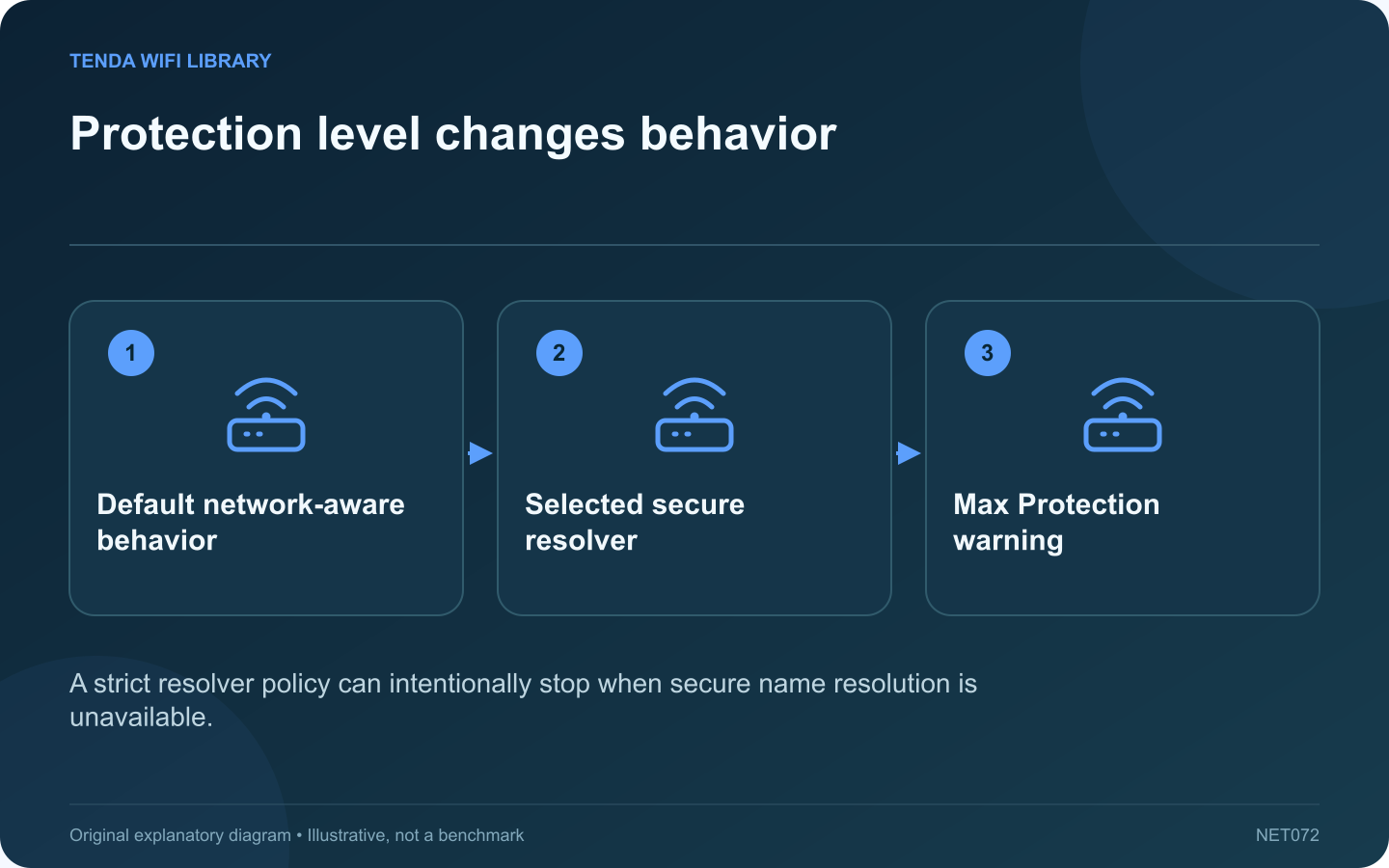
Protection level changes behavior: Default network-aware behavior; Selected secure resolver; Max Protection warning
A strict resolver policy can intentionally stop when secure name resolution is unavailable.

Firefox can stop a page from loading when its selected secure DNS resolver is unavailable. Under Max Protection, that behavior can be intentional. It is different from the Wi-Fi adapter failing to connect or the entire household losing internet access.

Read the actual warning

Record whether Firefox reports a resolver connection problem or a missing address for the requested name. Check the exact hostname. Do not interpret every browser warning as a password or router signal issue.

Inspect the protection level

Mozilla documents Default, Increased and Max Protection choices for DNS over HTTPS. Max Protection continues to require secure DNS and displays a warning when the necessary resolver result cannot be obtained. Default behavior is more sensitive to network conditions and policies.

Confirm the reason for the choice

If you deliberately selected a particular provider, check its service status and official configuration. If an organization manages the browser, contact its administrator. A strict privacy choice should not be silently weakened merely to remove a visible message.

Make a diagnostic comparison

  • Check whether another ordinary public name fails similarly.
  • Compare another permitted application on the same device.
  • Record whether the issue appears only on one network.
  • Keep the selected protection level noted with the result.

Choose an informed correction

Repair an incorrect provider setting or follow the intended network policy. If you choose a different protection level on your own device, understand the resulting fallback behavior and verify that it still meets your privacy expectations.

A successful page load through another application establishes that some connectivity exists, but it does not prove Firefox’s selected resolver is reachable. Finish by testing the original hostname under the configuration you actually intend to keep. Avoid collecting unrelated browser changes that make the immediate warning disappear without explaining which requirement failed.

Sources and editorial notes

Sources checked 8–9 October 2026. Independent guidance and original illustrations; product comparisons use published specifications rather than hands-on benchmarks. Check the exact model, revision and regional documentation before changing settings.

Related guides

300 FAQs across our guide libraries

Quick answers

100 practical questions from Tenda WiFi Library.

Browse all 100 FAQs
Why can Firefox Max Protection stop DNS fallback?

Firefox can stop a page from loading when its selected secure DNS resolver is unavailable. Under Max Protection, that behavior can be intentional. It is different from the Wi-Fi adapter failing to connect or the entire household losing internet access. Record whether Firefox reports a resolver connection problem or a missing address for the requested name. Check the exact hostname. Do not interpret every browser warning as a password or router signal issue.

Read the full guide and sources
Why might Chrome DNS fail while Windows DNS succeeds?

A successful Windows name lookup and a failed Chrome page load can both be accurate observations. Chrome's Secure DNS configuration may select a different resolver path. Inspect that difference before assuming the router is returning inconsistent answers. Compare the exact name entered in Chrome with the name used in the diagnostic lookup. Redirected login services and subdomains can introduce additional names. A successful lookup for the main site does not prove that every dependent service resolves correctly.

Read the full guide and sources
Why might a server’s full name work when its short name fails?

An internal server may open when you use its full domain name but fail when you enter only its short name. That pattern suggests a name-completion issue worth investigating before changing the router's DNS provider. Obtain the intended name from the service owner or administrator. Do not guess internal domains or enter work credentials into a similarly named public site. Keep the comparison limited to a resource you are authorized to access.

Read the full guide and sources
How can proxy or PAC settings affect browser connectivity?

A computer can connect to Wi-Fi normally while web requests fail because its proxy configuration is unsuitable for the current network. A proxy is an intermediary for selected traffic, and an automatic configuration script can decide when that intermediary should be used. Note whether the browser mentions a proxy, tunnel or configuration script. Compare an unrelated application and another device on the same router. If other devices work, that supports investigating the affected computer before changing shared router settings.

Read the full guide and sources
Independent. Practical. Clear.

Tenda WiFi Library is an independent information website. We are not affiliated with or endorsed by Tenda. Product names belong to their respective owners.