Independent router help & how-tosHelping you find your connection.
The guide library

Windows says “action needed” on public Wi-Fi: complete the legitimate sign-in flow

Explore the guide library · Travel connection help

Recognize a captive portal and verify the network operator before entering information or changing security settings.
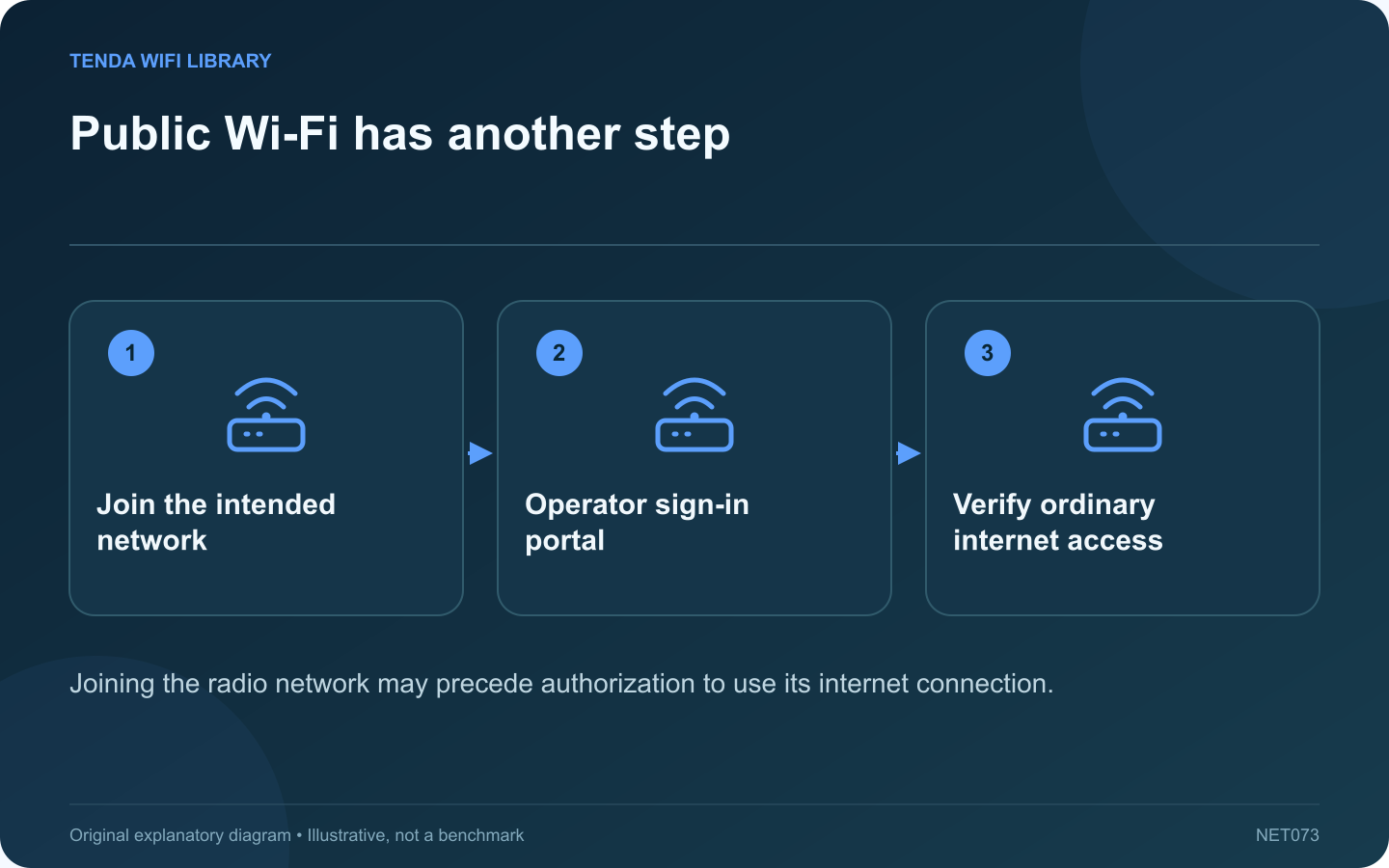
Public Wi-Fi has another step: Join the intended network; Operator sign-in portal; Verify ordinary internet access
Joining the radio network may precede authorization to use its internet connection.

Public Wi-Fi may require a sign-in or terms page after the computer joins the wireless network. Windows can report that action is needed because local association has succeeded while ordinary internet access remains restricted.

Verify the network operator

Confirm the correct network name with the venue’s official instructions. A familiar-looking hotspot name is not proof of ownership. Avoid entering unrelated account credentials into an unexpected page simply because it appeared after joining Wi-Fi.

Use the normal sign-in prompt

Microsoft describes captive-portal detection as part of Windows’ connectivity checks. Open the supported network sign-in flow when it appears and review the operator’s requirements. The user should decide whether to accept any terms or charges.

Keep browser identity checks intact

A certificate warning is not a routine button to skip in order to obtain internet access. Confirm the portal address with the operator and ask for help if its secure page cannot be verified. Do not install an unknown certificate profile or disable protection to proceed.

Check the result

  1. Finish the authorized portal flow.
  2. Confirm Windows updates its connection state.
  3. Open a normal public destination.
  4. Start the approved VPN if your work policy requires it.

Handle a missing portal

Check that the computer joined the intended network and ask the venue for its supported login procedure. A browser, proxy or managed-device policy may affect the flow. Do not change organization controls without administrator guidance.

When leaving, review whether the device should automatically rejoin that network in the future. A public hotspot is a temporary access arrangement, not evidence that the home router needs repair. Keep the stages distinct: wireless connection, network authorization and ordinary application access. That makes a failed sign-in easier to explain without resorting to broad network resets.

Sources and editorial notes

Sources checked 8–9 October 2026. Independent guidance and original illustrations; product comparisons use published specifications rather than hands-on benchmarks. Check the exact model, revision and regional documentation before changing settings.

Related guides

300 FAQs across our guide libraries

Quick answers

100 practical questions from Tenda WiFi Library.

Browse all 100 FAQs
What should I do when public Wi-Fi says action is needed?

Public Wi-Fi may require a sign-in or terms page after the computer joins the wireless network. Windows can report that action is needed because local association has succeeded while ordinary internet access remains restricted. Confirm the correct network name with the venue's official instructions. A familiar-looking hotspot name is not proof of ownership. Avoid entering unrelated account credentials into an unexpected page simply because it appeared after joining Wi-Fi.

Read the full guide and sources
Why might Windows Mobile hotspot connect without internet access?

A phone can successfully join a Windows Mobile hotspot while still lacking internet access. That proves the phone reached the laptop's hotspot, but the laptop must also have a working connection selected for sharing. Open an ordinary public page and the service you intend to use. If Windows itself has no internet, fix that source connection first. A public network may require a legitimate sign-in flow before it allows ordinary traffic.

Read the full guide and sources
What should I compare when Windows says connected but no internet?

A connected Wi-Fi indicator confirms part of the local connection, not every step needed to reach an application. Start by comparing your Windows laptop with another device on the same network. This simple test can prevent unnecessary changes to a working router. On the second device, confirm it is using the intended Wi-Fi rather than mobile data. Try the same website and another unrelated destination. If only one website fails on both clients, investigate that service before assuming the whole internet connection is down.

Read the full guide and sources
How can I compare IPv4 and IPv6 without disabling either?

Some connectivity problems affect one address family more than another. Windows tools can collect IPv4 and IPv6 observations separately. Use that evidence to locate a problem rather than disabling IPv6 permanently because one generic guide recommends it. Use a public service relevant to the failure and confirm that it publishes the address records needed for the comparison. A service with no IPv6 address cannot serve as a fair test of your IPv6 internet path.

Read the full guide and sources
Independent. Practical. Clear.

Tenda WiFi Library is an independent information website. We are not affiliated with or endorsed by Tenda. Product names belong to their respective owners.