Independent router help & how-tosHelping you find your connection.
The guide library

Use Zoom Web App statistics to investigate a choppy meeting

Explore the guide library · Video call quality

Record the affected media stream and timing instead of relying on a speed test taken after the meeting.
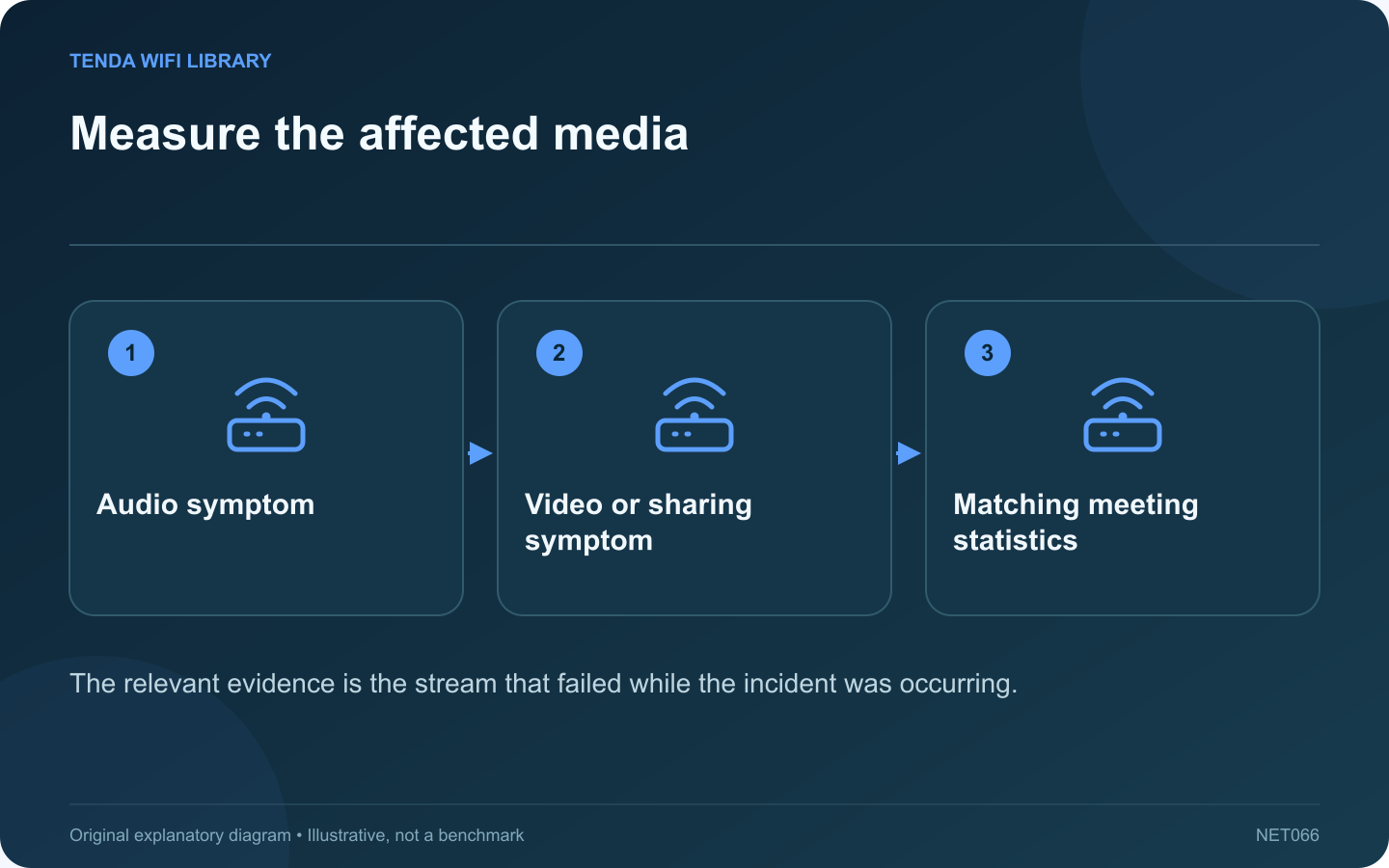
Measure the affected media: Audio symptom; Video or sharing symptom; Matching meeting statistics
The relevant evidence is the stream that failed while the incident was occurring.

A generic speed test after a Zoom meeting may look healthy even when participants experienced broken audio or frozen video. The Zoom Web App’s supported statistics view can provide information closer to the actual meeting traffic.

Describe who notices the problem

Ask whether others hear your audio breaking up or whether you hear theirs breaking up. Note whether video and screen sharing behave the same way. This separates outgoing, incoming and media-specific symptoms before anyone changes the router.

Open the supported statistics view

Zoom documents a Statistics section in the Web App settings with measures including latency, packet loss and jitter. Use the controls available in the current application and record the affected period. Interface details can vary with the version and meeting environment.

Collect context alongside numbers

  • Connection type and room.
  • Whether a large upload or download was running.
  • Whether the computer was heavily loaded.
  • Whether every participant or only one person was affected.
  • Whether the symptom stopped when a specific activity ended.

Make one controlled comparison

In a test meeting, compare the normal wireless path with an available supported wired path, or pause an optional transfer you control. Keep the same computer and application so the result has a clear interpretation. Avoid disrupting an important live meeting to run a capacity test.

Read the limits of the evidence

A statistic describes a particular observed stream and period. It does not automatically identify the failing router, provider or participant. Pair the measurement with the symptom and comparison rather than assigning blame from one brief spike.

Share only a reviewed screenshot or relevant figures through the appropriate support channel. Meeting names, participant details and shared content may be private. After a justified correction, verify the same media activity again. A smooth audio conversation is a more meaningful success measure than merely increasing the highest download number.

Sources and editorial notes

Sources checked 8–9 October 2026. Independent guidance and original illustrations; product comparisons use published specifications rather than hands-on benchmarks. Check the exact model, revision and regional documentation before changing settings.

Related guides

300 FAQs across our guide libraries

Quick answers

100 practical questions from Tenda WiFi Library.

Browse all 100 FAQs
What can Zoom Web App statistics tell me about a choppy call?

A generic speed test after a Zoom meeting may look healthy even when participants experienced broken audio or frozen video. The Zoom Web App's supported statistics view can provide information closer to the actual meeting traffic. Ask whether others hear your audio breaking up or whether you hear theirs breaking up. Note whether video and screen sharing behave the same way. This separates outgoing, incoming and media-specific symptoms before anyone changes the router.

Read the full guide and sources
Is a Teams Call health send limit my internet plan speed?

Teams Call health can show a send or receive limit much lower than the speed advertised by your internet provider. That does not mean the router has reduced the entire connection to that value. The statistic belongs to Teams' current media behavior and conditions. Microsoft documents Call health under the meeting's More actions and Settings controls. It presents network, audio, video and screen-sharing information. Inspect it during the problem so the observation corresponds to the affected activity.

Read the full guide and sources
Can a replacement USB-C cable slow a dock’s Ethernet connection?

A longer USB-C cable can make a desk neater while quietly changing a docking station's behavior. If Ethernet slows or disappears immediately after a cable replacement, investigate the laptop-to-dock connection before replacing the network cable. Save active work and reconnect the original manufacturer-supplied host cable. Use the same laptop port and Ethernet connection. If normal behavior returns, the replacement host cable becomes a strong suspect, although the result alone does not identify its exact electrical limitation.

Read the full guide and sources
How can I investigate Wi-Fi failures after Windows resumes from sleep?

A connection that fails only after sleep deserves a different investigation from Wi-Fi that is unstable all day. Record the laptop's behavior immediately after waking and compare it with a normal restart. Avoid changing the router while the failure appears tied to one client's resume cycle. Note whether the laptop was on battery or external power, whether a USB dock was connected and how long it slept. Record whether the network disappears, authentication fails or the client connects without application access.

Read the full guide and sources
Independent. Practical. Clear.

Tenda WiFi Library is an independent information website. We are not affiliated with or endorsed by Tenda. Product names belong to their respective owners.